
1. Consumer Data Protection New York : Definitions and Legal Concepts
Consumer data protection refers to the mandatory framework that governs how organizations collect and store sensitive personal data within the state. The primary issue involves identifying whether an entity has implemented reasonable safeguards to protect private information from unauthorized access under the SHIELD Act. In conclusion, establishing clear data governance is the first step toward fulfilling the statutory duty of care owed to the public.
Statutory Privacy Obligations
The New York SHIELD Act requires any person or business owning private data of residents to maintain administrative and technical safeguards. This rule defines private information to include social security numbers and biometric data that could facilitate identity theft if exposed. Courts evaluate whether the security program was proportional to the size of the business and the sensitivity of the data handled. This includes mandatory protocols for data minimization and the secure disposal of obsolete records to prevent latent vulnerabilities. Meticulous adherence to these standards is a prerequisite for defending against allegations of professional negligence. Proper classification of data assets provides the necessary foundation for a resilient compliance strategy that withstands intense regulatory audits.
2. Consumer Data Protection New York : Response Protocols for Violations
The core issue during a security failure involves the immediate execution of notification procedures required by the New York General Business Law. Under current rules, an organization must inform affected residents and the Attorney General if a material breach of consumer data protection occurs. Ultimately, a rapid and transparent response is necessary to mitigate long term legal exposure and protect the company reputation.
Mandatory Notification and Claims
When a violation is detected, the entity must provide a clear description of the categories of information exposed and the steps taken to neutralize the threat. New York law mandates that the Attorney General must be notified if the breach affects more than five hundred residents within the jurisdiction. Failure to satisfy these notice requirements can lead to separate civil penalties and may serve as evidence of gross neglect during a subsequent trial. Victims have the right to seek damages if the exposure resulted from a systemic failure to implement industry standard encryption methods or multi factor authentication. Practitioners must verify that all digital logs are preserved to support a factual defense during the discovery phase of litigation. Proactive management of these response protocols is the hallmark of a responsible and legally sound organization in a high risk digital environment.
3. Consumer Data Protection New York : Role of Specialized Legal Counsel
Consumer data protection matters require a sophisticated approach to risk management where an attorney acts as the primary investigator of corporate compliance. The challenge for many firms is coordinating between technical departments and legal teams to ensure that all internal policies satisfy the rigorous standards of the state hierarchy. Professional advocacy ensures that the corporate veil remains intact and that individual rights are asserted with technical precision in the Supreme Court.
Managing Technical Discovery and Audits
Specialized counsel performs deep due diligence to identify potential vulnerabilities in the organizational hierarchy and recommends permanent structural reforms to prevent recidivism. This process often involves the review of SOC2 compliance reports and internal server configurations to verify that the entity met its fiduciary obligations. In the event of a lawsuit, legal experts manage the exchange of complex forensic evidence to prove that the company acted in good faith and met its statutory duties. They also evaluate whether third party vendors contributed to the failure, potentially shifting a portion of the financial liability away from the primary entity. Utilizing expert cybersecurity advice allows for the early identification of legal risks before they escalate into expensive class action scenarios. This strategic oversight is essential for protecting the long term stability and reputation of the business in a global market.
4. Consumer Data Protection New York : Case Studies and Judicial Outcomes
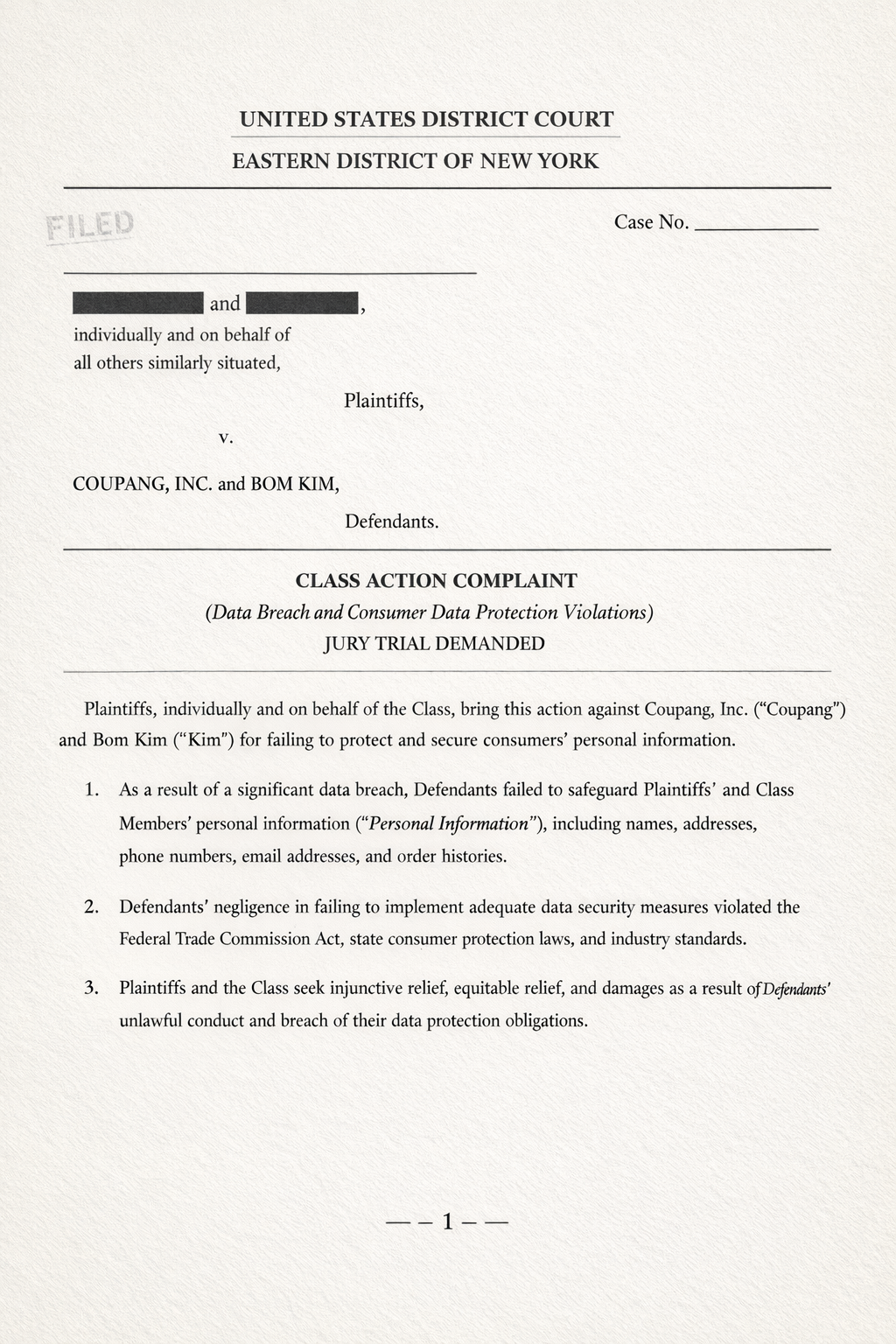
The final phase involves analyzing recent case studies where management neglect led to massive unauthorized exposure and subsequent collective litigation in the New York courts. For example, a recent complaint against a global retailer highlighted how the failure to allocate adequate budgets for security directly facilitated a catastrophic breach of consumer data protection. Applying these judicial precedents allows victims to hold negligent executives personally accountable for their systemic decision making failures.
Class Action Litigation for Data Breaches
In high profile cases, the court examines whether the CEO or the board of directors exercised actual control over the policies that allowed the exposure to occur. New York courts are increasingly scrutinizing the causal link between the lack of investment in security and the resulting financial harm suffered by the class members. The attached complaint image illustrates a standard legal filing where multiple counts of negligence and unjust enrichment are asserted against both the corporate entity and its leadership. These actions often seek significant monetary relief for victims and mandatory permanent injunctions to force better security practices across the entire organization. Successfully navigating a data breach lawsuit requires the synthesis of forensic data and persuasive legal arguments to secure a just settlement. The following table summarizes the primary claims asserted in these complex market disputes:
| Claim Category | Legal Description and Impact |
|---|---|
| Negligence | Failure to implement reasonable security standards as mandated by law. |
| Unjust Enrichment | Profiting from revenue that should have been spent on data protection. |
| Breach of Contract | Violation of the implicit promise to keep user information confidential. |
| Deceptive Acts | Misleading the public regarding the actual safety of the infrastructure. |
10 Feb, 2026
