


1. OSHA Enforcement Priorities and Regulatory Shifts
OSHA’s enforcement strategy has shifted toward aggressive "National Emphasis Programs" (NEPs), targeting specific high-consequence hazards such as extreme heat, fall protection, and silica exposure.
In the current regulatory environment, the agency utilizes programmed inspections to identify systemic failures in safety management before a catastrophic event occurs. A failure to demonstrate a comprehensive hazard prevention program during an unannounced inspection frequently triggers an expanded investigative scope.
- Heat Injury and Illness Prevention:
Protecting workers from indoor and outdoor heat stress has become a year-round enforcement priority. SJKP LLP assists in developing Heat Illness and Injury Prevention Plans (HIIP) that satisfy the General Duty Clause.
- Silica Exposure and Respiratory Protection:
Increased scrutiny on respirable crystalline silica, particularly in construction and manufacturing, necessitates a clinical audit of exposure control plans and industrial hygiene monitoring.
- Workplace Violence Prevention:
While specific standards are still evolving for healthcare and social services, OSHA aggressively utilizes its general enforcement authority to penalize employers who fail to address foreseeable violence risks.
By aligning your safety programs with these enforcement priorities, SJKP LLP ensures that your organization remains a "low-interest" target for federal and state-level inspectors.
2. Injury and Illness Recordkeeping: The Electronic Submission Mandate
Injury and Illness Recordkeeping is a mandatory operational safeguard where the clinical accuracy of OSHA Logs determines an organization's inspection risk profile.
Since the implementation of expanded electronic reporting requirements, certain high-hazard employers with 100 or more employees must submit Forms 300, 300A, and 301 through the Injury Tracking Application (ITA). OSHA utilizes this data to drive its Site-Specific Targeting (SST) inspections, focusing on establishments with unusually high or "suspiciously low" injury rates.
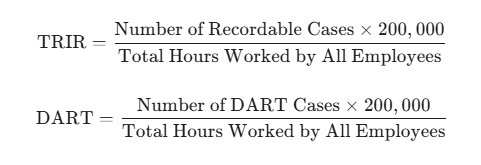
Calculating Recordable Incident Rates (TRIR and DART)
Regulators use the Total Recordable Incident Rate (TRIR) and the Days Away, Restricted, or Transferred (DART) rate as primary metrics for identifying high-risk worksites. These rates are calculated using the following LaTeX formulas:
Data Integrity and Underreporting Risks
Maintaining auditable workflows for restricted duty and medical treatment beyond first aid is a jurisdictional priority. Inaccurate or inconsistent data in your OSHA Logs can trigger a records-only inspection that often escalates into a full-site walk-through. We provide the forensic oversight required to audit your incident documentation for consistency and technical compliance.
3. Multi-Employer Worksite Policy: Jurisdictional Liability Mapping
The Multi-Employer Citation Policy represents a significant jurisdictional trap, where an employer can be cited for a hazard even if their own employees were not directly exposed.
OSHA recognizes four distinct roles on a shared jobsite, each carrying specific legal obligations to identify and correct hazardous conditions. A failure to manage subcontractor safety through rigorous contractual and field oversight frequently leads to "controlling employer" liability.
The Controlling Employer and Reasonable Care
A "controlling employer," such as a general contractor or site manager, must exercise reasonable care to prevent and detect violations on the site. While this duty of care is less than that required for their own employees, it necessitates "frequent and regular inspections" by a designated competent person.
Creating and Exposing Employer Obligations
Any employer that introduces a hazard (Creating) or whose employees are in the zone of danger (Exposing) is citable. SJKP LLP assists in drafting multi-employer safety agreements that strictly define reporting chains and corrective action protocols, isolating your organization from the negligent acts of third-party contractors.
4. Hazard Communication (HazCom) and Global Alignment
Hazard Communication remains one of the most frequently cited OSHA standards, requiring the clinical management of chemical classifications, labeling, and Safety Data Sheets (SDS).
Recent updates to the Hazard Communication Standard (HCS) aim to align U.S. regulations with the Globally Harmonized System (GHS). A failure to update written HazCom programs or training materials to reflect these phased changes can result in systemic "Other-than-Serious" citations that elevate your company's risk profile.
- Phased Compliance Deadlines:
Manufacturers and distributors must align with updated chemical classifications and labeling requirements by specific milestones. Employers must ensure all workplace labeling and written programs are updated shortly thereafter.
- Safety Data Sheet (SDS) Management:
Maintaining an accessible and current SDS library is a mandatory procedural safeguard. We perform "gap analyses" to identify outdated chemical inventories and training deficiencies.
- Employee Training and Comprehension:
OSHA requires that training be conducted in a language and manner that employees understand. SJKP LLP provides the professional guidance needed to validate your training quality and documentation integrity.
5. Whistleblower Protection and Anti-Retaliation Integrity
Whistleblower protection is a critical jurisdictional priority where the clinical management of employee complaints determines an organization’s exposure to federal litigation.
OSHA’s Whistleblower Protection Program enforces anti-retaliation provisions across more than 20 federal laws. Any "adverse action" taken against an employee who reports a safety hazard or workplace injury—including termination, demotion, or even subtle isolation—can trigger a federal investigation with a very low evidentiary threshold for the employee.
Defining Retaliatory Adverse Actions
Retaliation encompasses more than just firing; it includes disciplining, denying benefits, or creating a "constructive discharge" environment. SJKP LLP manages these sensitive matters with practical decisiveness, implementing anti-retaliation programs that focus on management leadership and transparent reporting chains.
The Five Elements of an Effective Anti-Retaliation Program
To mitigate the risk of a whistleblower claim, we recommend a program centered on:
- Management leadership and accountability.
- A system for listening to and resolving concerns.
- A formal response protocol for retaliation allegations.
- Regular anti-retaliation training for supervisors.
- Independent program oversight.
Managing Federal Injunctions and Reinstatement
If OSHA determines that retaliation occurred, the Secretary of Labor can sue in federal court to obtain immediate relief, including back wages and employee reinstatement. We provide the aggressive advocacy needed to investigate complaints internally and remediate issues before they escalate into an enforcement action.
6. Why SJKP LLP stands as the Authority in OSHA Compliance Matters
Selecting SJKP LLP to manage your OSHA Compliance and Workplace Safety Governance ensures that your organization is protected by a firm that treats safety risk as a high-stakes jurisdictional priority. We recognize that for our clients, the true risk of an OSHA citation is not just the fine, but the terminal impact on your Reputation, insurance premiums, and ability to bid on high-value contracts. Our firm provides a firm legal safeguard, integrating judicial advocacy with a deep understanding of the current regulatory environment surrounding NEPs, recordkeeping mandates, and whistleblower protections.
We do not simply offer general guidance; we build proactive strategies that identify potential "Repeat" or "Willful" triggers, evaluate the strength of your jurisdictional defenses, and assess the validity of your safety programs with clinical precision. Our senior partners take a hands-on approach to every engagement, ensuring that you have the most experienced minds at the table during every board meeting and every high-stakes negotiation with federal regulators. At SJKP LLP, we believe that the legal system should provide a clear and fair path for enterprises to achieve their strategic objectives through disciplined and safe operations.
19 Jan, 2026
