



1. What Security Deposit Law Regulates in New York
Purpose of Security Deposits
A security deposit is legally defined as the tenant’s property held in trust by the landlord. Its sole purpose is to protect the owner against unpaid rent or physical damage to the premises that exceeds "ordinary wear and tear." Courts apply security deposit law to ensure deposits are not used as unlawful rent or penalty substitutes. If a landlord treats the deposit as a "move-out fee" or an automatic cleaning charge, they are in direct violation of the statutory framework.
Legal Limits on Deposit Handling
Under the current 2026 standards, the maximum amount a landlord can request as a security deposit for a residential unit is strictly capped at one month’s rent. Any demand for "last month’s rent" in addition to a security deposit is generally viewed as an overcharge. Furthermore, the law regulates the "burn rate" of these funds, ensuring they remain liquid and separate from the landlord’s personal or operating capital.
2. Landlord Obligations under Security Deposit Law
Holding and Safeguarding Deposits
New York General Obligations Law requires that deposits be held in an interest-bearing account in a New York-based banking organization. The landlord is prohibited from commingling these funds with their own assets. Commingling is considered a terminal breach of the landlord’s fiduciary duty; once funds are mixed, the landlord generally loses all legal right to use that deposit for repairs or unpaid rent, regardless of the damage caused by the tenant.
Required Disclosures and Records
Upon depositing the funds, the landlord must provide the tenant with written notice stating:
- The name and address of the banking institution.
- The amount of the deposit.
- The interest rate (if applicable). Landlords are entitled to retain a 1% administrative fee from the interest earned, but the principal and the remainder of the interest belong solely to the tenant. A failure to provide these disclosures is often used in housing disputes as evidence of a landlord’s non-compliance with the "procedural rails" of the law.
3. When Security Deposit Deductions Are Lawful
Permissible Deductions
Under Under landlord-tenant law, a landlord may only deduct from the deposit for:
- Unpaid Rent: Any arrears owed at the conclusion of the tenancy.
- Physical Damage: Actual destruction of the property caused by the tenant or guests.
- Non-standard Cleaning: Costs to return the unit to a "broom-clean" condition, beyond typical turnover cleaning.
Wear and Tear Vs. Damage
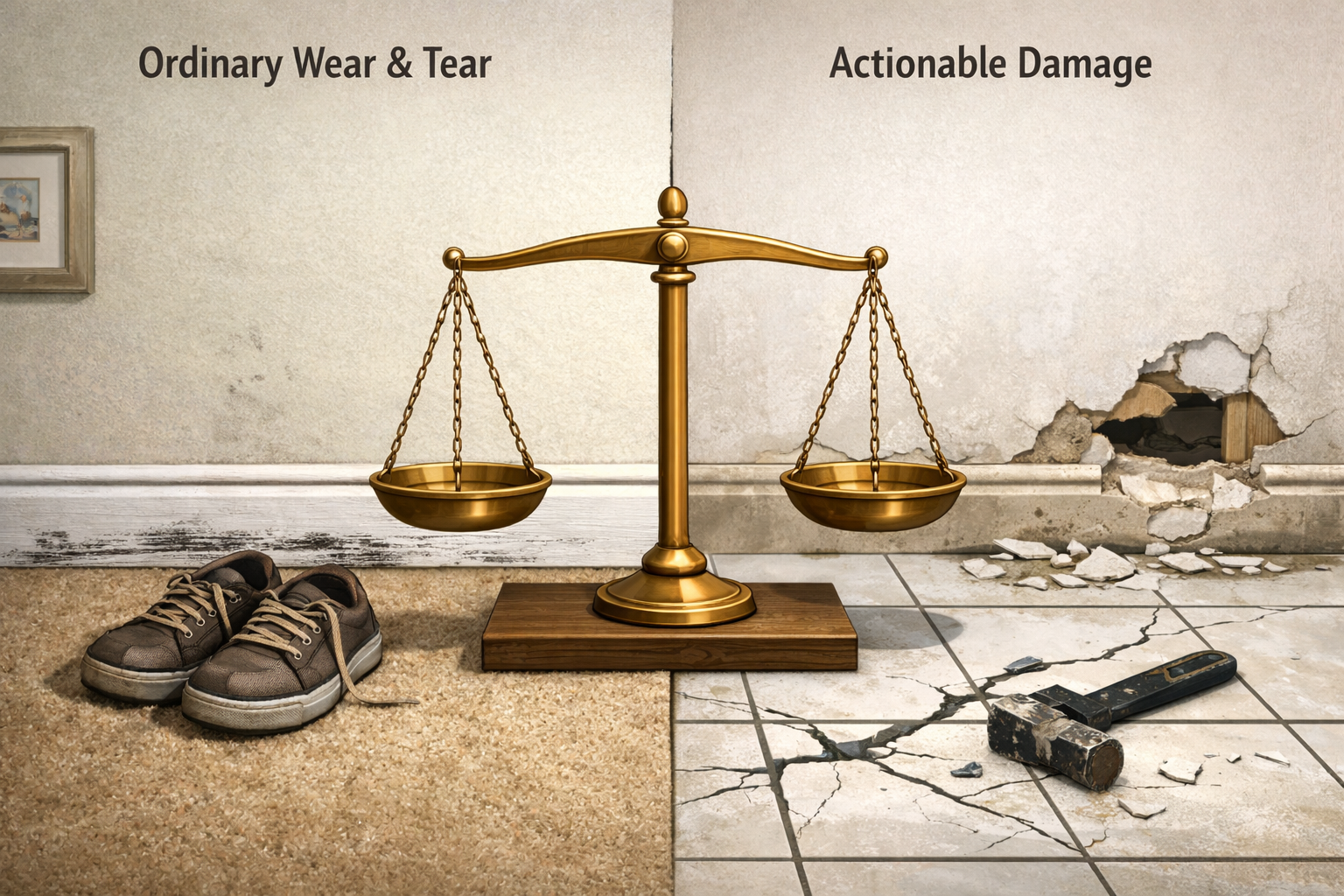
This is the central battlefield of security deposit litigation. The law distinguishes between “ordinary wear and tear”(the natural deterioration of a properties like faded paint, worn carpet pile, small nail holes)and "actual damage" (e.g., broken windows, large holes in drywall, or pet-related floor destruction). Landlords who attempt to charge tenants for the cost of "refreshing" a unit for the next occupant are often found to have made unlawful deductions.
4. How Courts Evaluate Security Deposit Disputes
Burden of Proof
In a deposit return case, the initial burden is on the tenant to show they paid the deposit and vacated the unit. The burden then shifts heavily to the landlord to prove, with "clear and convincing" evidence, that the deductions were justified. In security deposit disputes, courts focus on compliance with statutory timelines and whether deductions were properly documented.
Documentation and Timelines
The court performs a forensic audit of the landlord’s compliance with the "initial inspection" requirements. Under New York law, the landlord must notify the tenant of their right to a pre-departure inspection. Following this inspection, the landlord must provide an itemized list of proposed repairs, giving the tenant a final opportunity to cure the issues. If the landlord fails to offer this inspection or provide the preliminary list, they may be barred from making any deductions for physical damage.
5. When Withholding a Security Deposit Becomes Unlawful
Failure to Return within Required Time
As of 2026, the 14-day rule is the absolute standard for New York residential tenancies. Within 14 days of the tenant vacating the premises, the landlord must:
- Return the full deposit, OR
- Provide a clinical, itemized statement justifying any deductions, accompanied by the remaining balance. If the landlord fails to provide the itemized statement within this 14-day window, they forfeit the right to retain any portion of the deposit—even if the tenant burned the building down.
Improper or Undocumented Deductions
Even if provided on time, a deduction is unlawful if it is not "documented." The itemized statement cannot be a list of "estimates"; it must reflect the actual cost of repairs. In high-stakes housing disputes, courts look for receipts, invoices from third-party contractors, and date-stamped photographs. Estimates or "internal labor" charges are frequently struck down by judges as being unsubstantiated.
6. Remedies for Security Deposit Law Violations
Deposit Return and Penalties
The baseline remedy is the return of the full deposit. However, New York law allows for "punitive" recovery. If a court finds that a landlord "willfully" violated the law(such as intentionally ignoring the 14-day rule or commingling funds) the landlord may be liable for treble damages (three times the amount of the deposit).
Statutory Damages and Interest
Beyond the triple damages, the landlord may be ordered to pay:
- The tenant’s legal fees and court costs.
- Accumulated interest at the statutory rate.
- Injunctive relief to prevent future violations in multi-unit buildings. For many landlords, an improperly handled $3,000 deposit can quickly escalate into a $15,000 liability once legal fees and penalties are calculated.
7. Why Legal Review Matters in Security Deposit Disputes
06 Feb, 2026
